
Read Wabash County Deed Records
The Wabash County Recorder is the office of record for deeds. It also files mortgages, releases, liens, plats, easements, contracts, powers of attorney, affidavits, and surveys. It also files annexations. A deed records a transfer of an interest in land. The index gives you the parties. It also lists a filing reference. For the exact terms and legal description, you need the image or a certified copy.
| Deed Type | What It Does | Common Use |
|---|---|---|
| Warranty deed | Conveys land with stated title promises | Ordinary purchase transfer |
| Quitclaim deed | Passes whatever interest the grantor holds | Family or title cleanup transfer |
| Executor deed | Transfers land through an estate representative | Probate administration |
| Trustee deed | Conveys under trustee authority | Trust or authorized sale |
| Tax or sheriff deed | Records a transfer after a statutory process | Tax sale or court-directed sale |
Not every instrument works like a deed. A mortgage or lien burdens the land without conveying it. RMIS indexes assignments and releases. It also covers federal and state tax liens, mechanic liens, lis pendens, rights-of-way, plats, and covenants. Reading these instruments around a conveyance can explain why a later deed was signed. It can also show why another claim needs review.
Search Wabash County Deeds in RMIS
Wabash RMIS Public Web sorts its search fields into Instrument, Party, Platted Property, Unplatted Property, and GIS Address. Options and templates come last. None of the fields is required. Start narrow anyway. A date range and instrument type narrow things further. Party role will keep a common surname from flooding the results. Book and page or a document ID pulls up a known filing fast.
| Index field | Choice or format | Deed use |
|---|---|---|
| Party Name | Semicolon for more than one; starts-with defaults on | Grantor or grantee trail |
| Party Type | Grantor, grantee, and other roles | Separate seller from buyer |
| Date Recorded | From and through dates | Narrow a transfer period |
| Book / Page / Doc Id | Direct document references | Retrieve a cited deed |
| Subdivision / Lot or Section / Township / Range | Platted and rural criteria | Keep the land match stable |
RMIS lets you show one party, every matching name, or all party information. Take the fuller view for trusts, estates, or multi-party conveyances. The official RMIS form displays these choices.
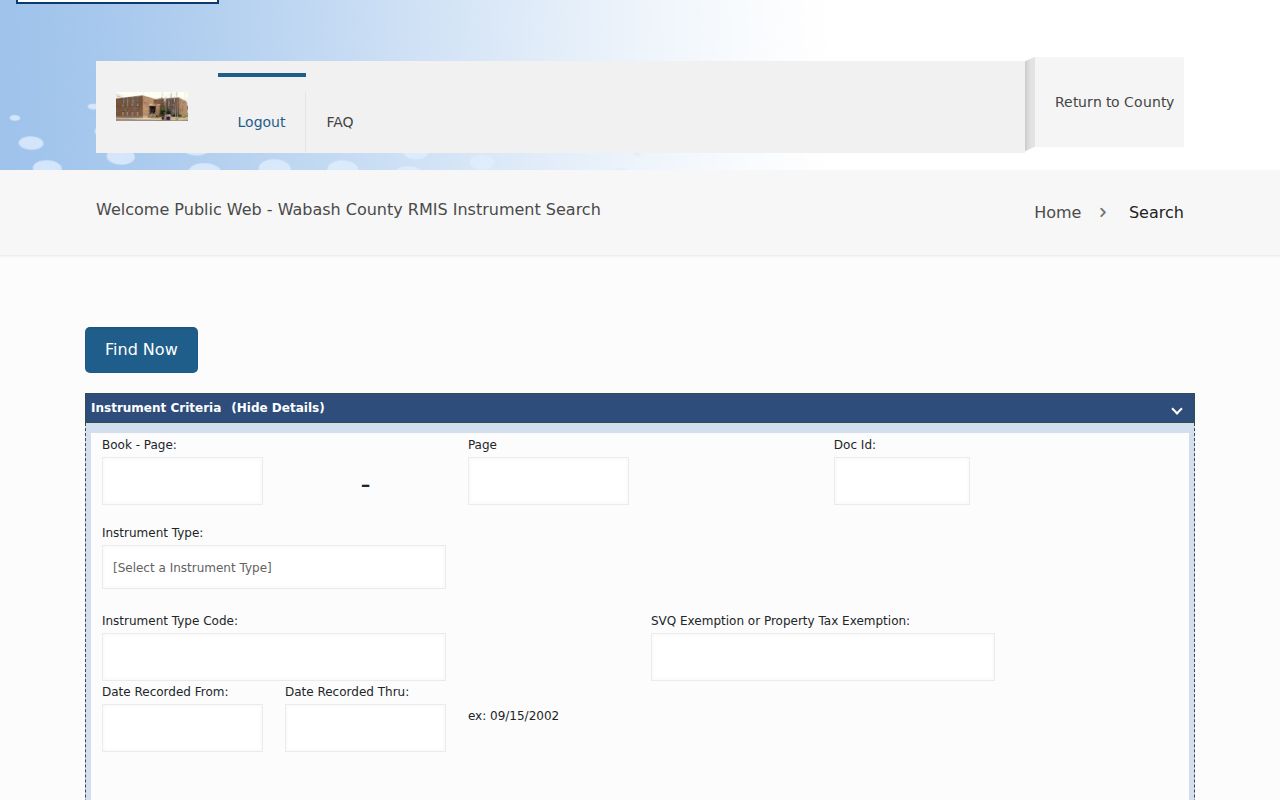
Separate land and address criteria make the index useful even after a party's spelling has changed.
Free Index Clues Versus Deed Images
The Recorder's free Records Search Only route tells you whether a filing exists. It returns the recording date and document number. It does not return images. Tapestry is the one-time paid route for search and images. Laredo bills monthly, with view, image, and print charges. Official Wabash sources do not publish the online index's first year. An empty web result does not mean no deed exists.
Courthouse staff can help you find the index entry and supply plain or certified copies. Phone, email, and mail requests work too, if you give enough detail. Include names, a date range, the property address, parcel PIN, and legal description. Also list any book, page, or document ID already found.
Note: A free index hit is only a locator. Get the image or certified copy before relying on the deed's exact language.
Wabash Recording Rules Explain Filing Delays
Wabash accepts e-recording, yet the Recorder excludes documents that transfer property. Deeds and affidavits must be filed in person. Mortgages, releases, and assignments may be e-recorded. A transfer should name its preparer and carry acknowledgment. It must show legible names exactly as signed. It should also include the notary county and commission expiration. Auditor endorsement is required in some cases.
The first page needs ten-point type and two-inch top and bottom margins. Documents arriving after 3:00 p.m. may be processed the next business day. These rules explain why the signed date and the recorded date often differ. They also warn against treating a closing date as proof of the current owner. The recorded instrument sequence is the true county trail.
Follow Wabash County Deed Records by Party
A grantor gives the interest. A grantee receives it. Start with the newest known conveyance, read both parties, and carry the same legal description through every step. The county index may list several parties or a precise entity name, so keep initials, suffixes, trust wording, and company punctuation rather than simplifying them.
- Find the present acquisition deed by searching the current owner as grantee.
- Read its grantor, recording date, document reference, and legal description.
- Search that grantor as an earlier grantee and confirm the same land description.
- Repeat until RMIS stops, then move to deed-book indexes and microfilm.
- Grantor
- The party transferring an interest.
- Grantee
- The party receiving an interest.
- Chain of title
- The ordered sequence of transfers affecting the same land.
- Book and page
- A volume reference, distinct from a newer document ID.
Wabash County Deed Books Survived the Fire
Two official histories disagree on the courthouse fire date. One says 1870; the other says June 17, 1871. Either way, the practical point stands. Fireproof rooms preserved the Recorder, Auditor, Treasurer, and Clerk records. Early county land records did not vanish just because the courthouse burned.
The Indiana State Library Wabash County guide and its microfilm inventory extend the trail offline. Holdings include deed indexes for 1835 through 1897. Deed or index books run into 1901. The inventory also lists an 1826 through 1850 tract book and 1847 assessments. Partition records, probate order books, and civil court material appear there too. These companion series may explain an early split or transfer.
Match Every Wabash Deed to the Land
Names alone do not build a chain. At each step, compare subdivision, lot, block, section, township, range, government lot, acreage, metes-and-bounds notes, and parcel PIN. A party may have owned several Wabash County tracts. An old parcel may have been split or combined later. RMIS holds both platted and unplatted fields to keep that geographic thread intact.
Beacon can help locate the modern parcel. Its legal-description display warns against use on legal documents. A recorded deed or plat controls the wording. A probate order, partition, foreclosure, or tax proceeding can break a simple grantor-grantee sequence. Use the Clerk's court file for context, then return to the next recorded conveyance.
Wabash Deed Copy and Recording Fees
Wabash County charges $25 to record a deed or similar instrument. That fee covers one oversized page. A mortgage runs $55, whether it is subordinate or being re-recorded. Each additional page over 8.5 by 14 inches adds $5. Copies are cheaper. Anything at 11 by 17 inches or smaller costs $1 per page. Larger copies cost $5, and certification adds $5. Schedules change, so confirm the amount before you pay.
These recording charges cover filing, not searching. The office opens its records for public inspection on weekdays. Military discharge records stay restricted, though. Indiana's public-record law also lets you submit a reasonably particular request for any existing record. It does not oblige the Recorder to build a title opinion or fresh analysis for you.
Obtain a Wabash County Deed Copy
Give the Recorder an exact index reference. You can go in person or by mail. The office sits at 1 W Hill Street, Suite 105, Wabash, Indiana 46992. Hours run Monday through Friday, 8:00 a.m. to 4:00 p.m. The office answers at 260-563-0661 extension 1253 and recorder@wabashcounty.in.gov. Say plainly whether you want a plain copy or a certified copy. Ask for a quote before sending any payment.
A mailed or emailed inquiry works better with detail. Include the grantor and grantee names and the approximate date. Add the instrument type, the parcel PIN, the legal description, and a document ID or book and page. If an online cutoff interrupts your search, name the deed-book or microfilm range instead. That gives staff a specific record to pull rather than a vague request to trace ownership.
Recorded, not guaranteed. The Wabash County index shows filed instruments, not a title opinion; unrecorded interests or defects may still exist.
Search Older Wabash County Deed Records Offline
An empty RMIS result does not prove an older transfer went unrecorded. The public form and the Recorder page never state the first year available online. The Indiana State Library inventory confirms Wabash County deed indexes from 1835 through 1897. It also lists deed and index volumes reaching into 1901. Its catalog extends beyond deeds. Tract, partition, probate, assessment, and court material can clarify how an early parcel changed hands.
Start from the earliest firm deed reference you found online. Then search that grantor in the older grantee index. Keep book, page, date, parties, acreage, and legal description together in one place. Contact the State Library about microfilm access. Ask the Recorder about the original or an official copy. That handoff keeps the chain intact without inventing an online cutoff Wabash County never published.
Connect Wabash County Deed Records to Probate
Land from a decedent can travel by executor deed, trustee deed, court order, affidavit, or a later conveyance rather than an ordinary sale. RMIS instrument labels cover estate, order, last will and testament, and executor and trustee deed variants. Search the deceased owner as both grantor and grantee. Then match the legal description and recording dates across the results.
The Wabash County Clerk holds probate and court files at the Judicial Center. A historical research request can pinpoint an existing case when you supply names, approximate dates, case type, and the copy you want. The probate order establishes authority. The Recorder's deed records the transfer of land itself. Neither record substitutes for the other.
Verify Wabash County Deed Records Before Reliance
Read the full instrument, not just its index label. A warranty deed, quitclaim deed, mortgage release, easement, or lien carries legal terms. No document type can reveal those terms on its own. Compare the acknowledged parties and the legal description. Check the recorded date, the prior reference, and any Auditor endorsement too. Look for later releases or corrective instruments under the same names and parcel clues.
Use a certified copy whenever official wording must be produced. For a purchase, boundary dispute, estate, or another high-stakes title question, a professional title examination may be necessary. Wabash County deed records show what was filed. But they cannot resolve every defect or unrecorded claim.